
Remembering a Kite Master
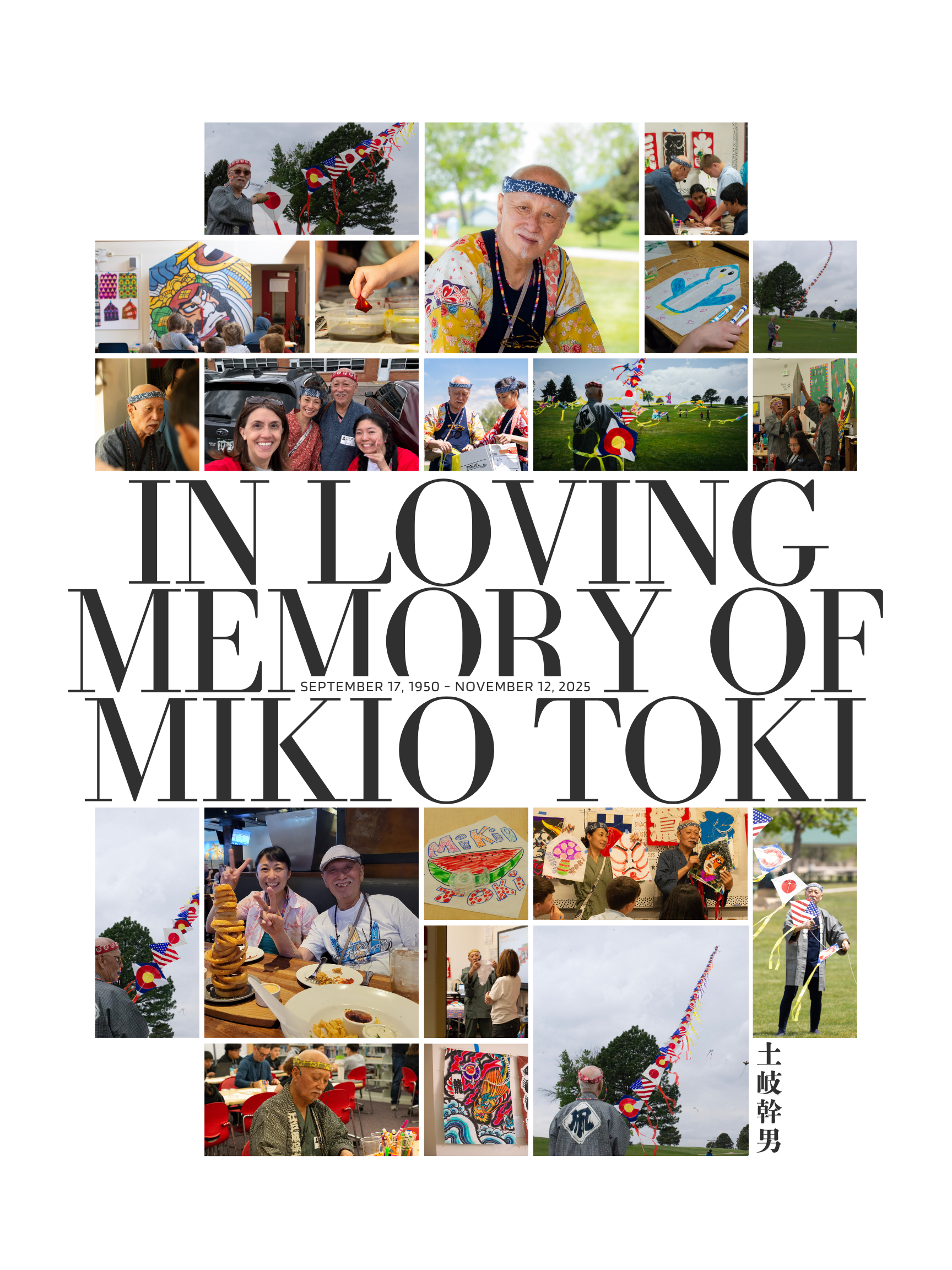
Every year for more than a decade, for a few days in early summer, the skies near Denver have been filled with colorful magic. Hundreds of kites—some with intricate designs, others simple colored diamond shapes with long tails—have delighted children and adults alike. These kites were inspired and created under the guidance of Edo Kite Master Mikio Toki, who visited Colorado annually from his town of Chiba, Japan. At the invitation of the Japan America Society of Colorado (JASC), Master Toki shared his love of kite making and its place in Japanese culture with Coloradans of all ages from 2014 through 2025, inspiring the creation of over 6,400 kites over the years.
Today, we mourn the passing of Kite Master Mikio Toki, who died on November 12, 2025. Yet we also remember and celebrate the joy he brought us and the cultural connection to Japan he promoted through this ancient art.
Kite making in Japan is deeply embedded in the country’s culture and history, holding significance beyond a mere recreational activity. It is a blend of art, tradition, and spirituality, often associated with celebrations and prayers. Today, there are hundreds of varieties of kites in Japan, with each region having its own distinctive style. Kites are flown during New Year’s celebrations as a symbol of good fortune; they are used to honor the birth of a child; and they are flown at festivals to ward off evil spirits and bring blessings to the community.
Master Toki specialized in Edo kite making. The Edo period (1603–1868) was characterized by feudal Japan, shogun, and samurai. When visiting schools in Colorado, Master Toki delighted students by dressing in Edo‑period artisan clothing. He often played his hand‑made bamboo flute while telling stories, before guiding students through the art of making their own kites using materials he brought from Japan, including washi paper and bamboo. His own kites, displayed in museums around the world, are works of art depicting samurai, nature scenes, Japanese kanji, and kabuki characters.
Derek Okubo, board member of JASC, reflected: “Toki-san was like a sun-filled spring day with a cool, steady breeze. His kindness and patience with young people was truly something special to witness. He let children be themselves and had a way of bringing out the child in all of us. Though I’m deeply saddened by his passing, thinking of him brings a smile to my face.” Stephanie Garnica, current JASC Board Chair, added: “He showed us that a kite is more than paper and string—it is a symbol of culture, history, and connection.”
Mikio Toki was a master of his art—a true Kite Master. For those of us who had the pleasure and honor of experiencing his passion firsthand, he was that and much more. He was a bridge between the people and cultures of Colorado and Japan. For the many students whose classrooms he visited over the years, he offered a glimpse into Japanese culture beyond anime, ramen, and sushi. For adults, he rekindled the magical childhood thrill of flying a kite on a sunny day. And for all, he reminded us of the close relationship between Japan and Colorado—indeed between Japan and the United States—a relationship that only a generation ago was marked by the worst of conflicts.
Master Toki passed on his love for kites and kite making to his daughter, Ms. Asami Toki. We sincerely hope to welcome apprentice Toki to Colorado in the coming years to continue her father’s legacy. In the meantime, we will remember his warm smile every time we see a kite rise into the sky.
Master Toki, may your skies be forever colorful. We thank you. We honor you. And we will remember you.
Written and Edited by: Claudine Locascio, Executive Director, and Inta Morris, JASC Board of Directors, served as president from 2021 to 2022.